

Wondering how to choose the right ski boots so they don’t pinch, while still giving you the control and support you need on the slopes?
Whether you are heading to a rental shop for the first time or considering investing in your own gear, getting the correct ski boot size is the single most critical technical factor affecting both your safety and comfort on the mountain.
In this practical guide from Snowflake Academy, you will find a step-by-step walkthrough on how to measure your feet, an explanation of the Mondopoint sizing system, and a clear ski boot size chart to help you easily navigate the options from major global manufacturers.
Ski boot sizing and the Mondopoint system
While you are probably used to standard European (EU) or UK/US sizing for regular shoes, when it comes to ski boots, you will run into a system called Mondopoint (MP). This is the most precise sizing method available, as it directly measures the length of your foot in millimeters or centimeters. Getting this measurement right is absolutely essential because a ski boot shell will not break in or stretch the way regular sneakers do.
How to accurately measure your feet for Mondopoint at home
You don’t need professional equipment to find your ski boot size; a simple home test is all it takes:
- Place a sheet of paper on the floor against a wall, and stand on it with your heel pressed firmly against the wall.
- Mark the tip of your longest toe with a pencil.
- Use a ruler to measure the distance from the wall to your mark in millimeters.
- Convert this measurement to centimeters and round up to the nearest 0.5 cm.

This final number is your Mondopoint size. For instance, if your ruler shows 26.3 cm, your ideal fit will most likely be a 26.5 MP ski boot.
Ski boot size chart for adults and kids
The following ski boot size chart serves as a universal converter between standard shoe sizes and the Mondopoint system. Keep in mind, however, that every manufacturer (such as Rossignol, Salomon, or Atomic) uses slightly different internal molds and shell shapes. Because of this, nothing beats physically trying them on at a shop or rental location.
| MONDOPOINT (in mm) | EUROPEAN SIZING | UK SIZING | US SIZING (MEN’S) | US SIZING (WOMEN’S) |
| 140 | 23 | Junior 6 | Junior 7 | Junior 7 |
| 150 | 25 | Junior 7 | Junior 8 | Junior 8 |
| 160 | 26 | Junior 8 | Junior 9 | Junior 9 |
| 170 | 27 | Junior 9 | Junior 10 | Junior 10 |
| 180 | 28,5 | Junior 11 | Junior 12 | Junior 12 |
| 190 | 30 | Junior 12 | Junior 13 | Junior 13 |
| 200 | 31 | Junior 13 | 1 | 1 |
| 210 | 33 | 1 | 2 | 2 |
| 220 | 35 | 3 | 4 | 5 |
| 230 | 36,5 | 4 | 5 | 6 |
| 240 | 38 | 5 | 6 | 7 |
| 250 | 39 | 6 | 7 | 8 |
| 260 | 40,5 | 7 | 8 | 9 |
| 270 | 42 | 8 | 9 | 10 |
| 280 | 43 | 9 | 10 | 11 |
| 290 | 44,5 | 10 | 11 | 12 |
| 300 | 46 | 11 | 12 | 13 |
| 310 | 47,5 | 12 | 13 | 14 |
Recreational skiers should go with their exact measured size, whereas performance-oriented or sports skiers often downsize by a half size for a tighter shell and more aggressive power transfer.
Kids’ specific ski boots: Don’t overdo the sizing
Parents often tend to buy gear “with room to grow” so it lasts for two seasons. When it comes to skiing, however, this is a dangerous approach. If a child’s ski boots are two sizes too big, their feet will “swim” inside them. This leads to a loss of stability, the development of bad technical habits while learning, and, last but not least, painful blisters caused by the sock rubbing against the inner liner.
For children, we recommend a maximum clearance of 1 cm (roughly a finger’s width behind the heel when the inner liner is removed). If you are looking for a solution to quickly growing feet, our ski rental shop in Jasná can adapt your child’s ski boots to their current size throughout the season, saving you from having to constantly buy new gear.
How to choose ski boots by width
Once you know your length, finding the right ski boot fit also requires considering the width of your foot (known as the “last”). Standard models typically range between 100 and 102 mm. If you have wider feet or a high instep, look for models labeled as “Wide” (104 mm).
The flex index and why it matters
Simply put, the flex index is a numerical value that represents the stiffness (hardness) of the ski boot shell. It tells us how much resistance the cuff (the upper part of the boot) offers when you press your shins forward into the tongue of the boot.
This parameter is the key to how efficiently you can transfer power from your legs to the edges of your skis, as well as how comfortable you will feel on the mountain. Therefore, it is just as crucial for choosing the right ski boots.
Here is how you should choose your flex index based on your experience level:
- Beginners (60 – 80): A soft boot that is highly forgiving of mistakes and comfortable enough for all-day wear.
- Intermediates (80 – 100): A medium stiffness that provides better control over your ski edges.
- Advanced & Experts (110+): A stiff shell designed for maximum precision and power transfer during high-speed charging.
Getting the perfect boot size combined with the right flex ensures that you won’t have to cut your ski day short after just two hours due to foot pain.
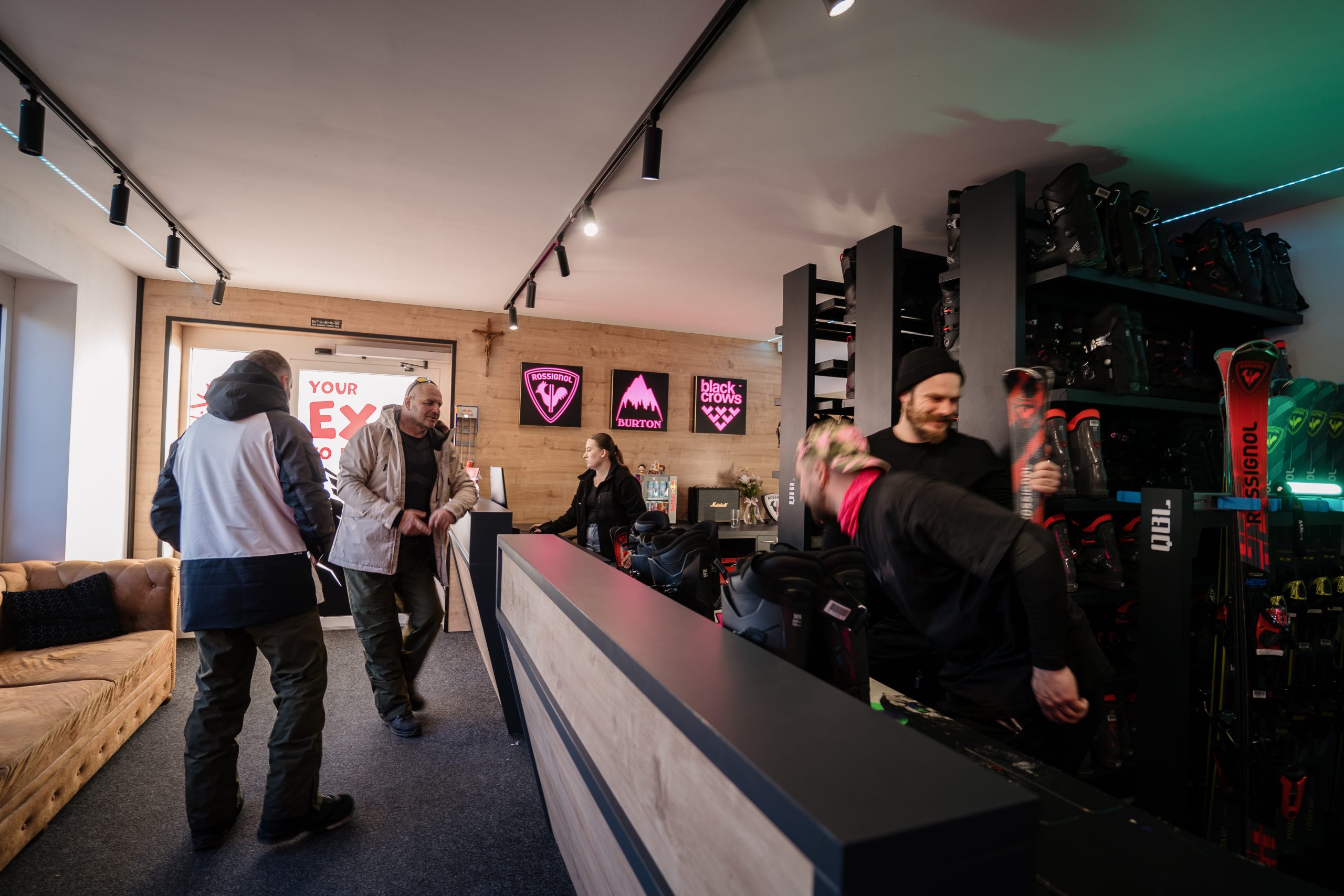
Your first visit to a rental shop: What to expect when trying on boots
If you are renting ski boots for the very first time, don’t be alarmed by a snug, pressurized feeling. A ski boot is not a bedroom slipper. When you first step into the boot and stand completely upright, your toes should gently brush the very front of the inside liner. This is completely normal. The moment you buckle up the boot and flex your knees forward (putting yourself into a skiing stance), your heel will slide back into the heel pocket, creating that necessary bit of breathing room for your toes in the front.
Practical tips for trying on ski boots
- Always wear just a single layer of high-quality, dedicated ski socks.
- Fasten your boot buckles progressively, starting from the bottom ones near your toes and working your way up to the top.
- Spend at least 10 to 15 minutes walking around the shop or rental station in the boots to allow the heat-moldable foam liner to start shaping around your feet.
From a comfortable fit to the pure joy of skiing
Picking out the right ski gear and boots is the ultimate first step toward truly enjoying your time in the mountains. If you are still unsure about how to choose the right ski boots, whether your selected boot size is actually the right one for you, or if you simply feel a bit anxious about your first day on the snow, we are here to help.
The specialists at the Snowflake rental shop are ready to professionally assess the anatomy of your feet and recommend the ideal model to keep you stable and completely pain-free. Once you are properly fitted, you can confidently dive into perfecting your technique under the guidance of our expert instructors at our ski school in Jasná.