

Are you wondering how to learn to ski as an adult, even if you’ve never stood on skis before or only tried it once on a high school ski trip? The good news is: it is never too late, and almost anyone who approaches skiing with a clear mind and patience can do it.
More and more people are hitting the slopes for the very first time in their thirties or forties – and while it might look like a sport only for the brave at first, those first independent turns are closer than you think. In this guide, we will walk you through the entire journey – from the right mindset, choosing gear and resorts, to a step-by-step skiing methodology.
Can you learn to ski as an adult? Is it too late?
The short answer is: absolutely not. In fact, an adult ski beginner has several advantages that children don’t. You can consciously listen to an instructor’s guidance, understand why a certain movement is made, and focus on the details. Where a child learns mostly through imitation, you can actually think through the skiing technique and repeat it purposefully.
Granted, adults tend to learn a bit slower and have a greater respect for falling—more on that later. But once you master the fundamentals of skiing, you open the door to a sport you can enjoy for decades. It doesn’t matter when you start, but how you approach learning to ski.
Mindset: The foundation of skiing on which all progress is built
It might surprise you, but the biggest obstacle to learning to ski as an adult usually isn’t physical fitness or technique – it’s your head. Fear, impatience, and comparing yourself to others can slow down progress more than anything else. That is why it pays to dedicate a few minutes or hours to how you set up your mind.
Don’t compare yourself to others
On the slopes, you will always find someone who skis better – and often it will be an eight-year-old child passing you with ease. Don’t take it personally. Everyone has their own pace, children learn motor skills differently than adults, and most importantly, that eight-year-old might have already been skiing for several years. The only comparison that makes sense is comparing yourself to who you were yesterday. If you made a turn today that you couldn’t pull off this morning, it is a success regardless of what everyone else is doing.
Set realistic goals in skiing
The goal for day one is not a red slope. It is comfortable movement on skis, your first slow-down using a snowplow, and the feeling that the skis are listening to you. By setting reasonable expectations, you will avoid frustration and enjoy every small step as a victory. Rather than expecting 100% performance right from the start, strive for a 1% (or okay, maybe a 2%) improvement every day. Most beginners can safely navigate a gentle slope after three to five days of a basic course—and that is a perfectly fine pace.
How to handle the fear of skiing
Fear is natural and it isn’t the enemy – it’s a signal that you take safety seriously. The best way to manage it is to start skiing on a gentle, clear slope where you have things under control. A slow pace, a calm instructor, and the awareness that learning how to fall can be practiced just like learning how to ride all help. Once you realize that falling on soft snow doesn’t have to be painful and certainly doesn’t mean you will break yourself apart, most of the anxiety will fade on its own. And a simple rule applies: the better your gear and the safer the slope, the less room is left for fear.
The right gear for your first ski trips
Good gear will make learning immensely easier – and conversely, unsuitable or poorly adjusted equipment can discourage you from skiing for good. In the beginning, you don’t need the most expensive gear, just stuff that fits and is forgiving of mistakes.
Skis and boots for a beginner
For your first runs, choose shorter and softer skis (roughly reaching up to your chin). They are easier to maneuver at low speeds and will forgive more mistakes during a turn. Ski boots are even more important – they are the shoes that hold your direction. When choosing ski boots, look for softer models with a lower “flex index” that wrap firmly around the foot without pinching; you should be able to gently wiggle your toes. The bindings must be adjusted precisely to your weight so that they release safely in a fall.
How to dress for skiing – the principle of layering
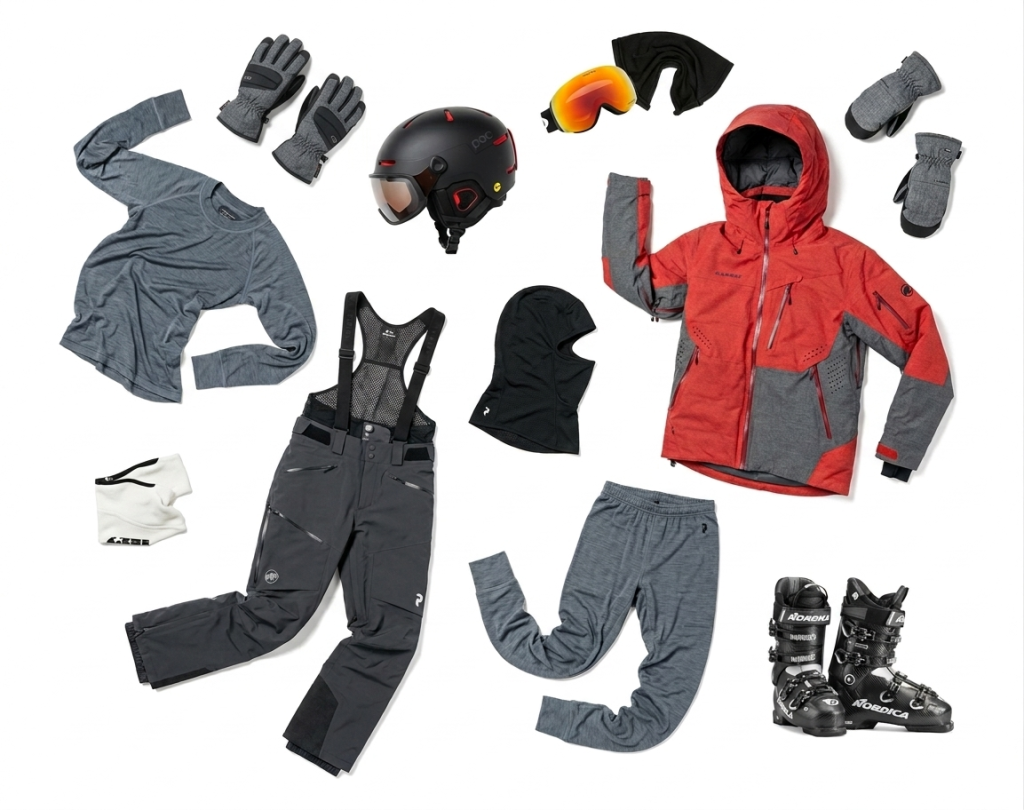
Cold and moisture will drain your focus much faster than fatigue. The baseline for dressing for skiing is layering: functional thermal underwear that wicks away sweat, a warm middle layer (fleece or a sweater), and a waterproof, breathable jacket and pants on top. Don’t forget ski socks (one thinner pair, not two thick ones), gloves, and a neck warmer.
Helmet, goggles, and poles
A helmet is a standard on the slopes today – it doesn’t just protect you from your own falls, but also from the mistakes of others. It must fit snugly even without the strap buckled. Ski goggles increase contrast, allowing you to better see uneven terrain, ice, or bumps, while protecting against the wind and mountain sun. Poles are not essential at the very beginning, but later they will help you with rhythm and balance.
If you don’t own gear, you don’t have to invest thousands of euros right away. A simpler and often smarter solution for your first attempts is to rent your equipment. At the Snowflake Academy ski rental shop, we will help you choose skis and boots according to your height, weight, and level, and we will adjust everything so that it fits you perfectly. Once you find out that skiing has hooked you, you’ll be in a much better position to choose your own gear.
Choosing a ski resort and slope for absolute beginners
Where you start skiing as an adult matters almost as much as who you start with and what gear you use. For your first days, look for a resort with wide, gentle slopes and avoid steep, crowded pistes where just standing in place stresses you out.
Across Europe, ski slopes share the same color-coding based on difficulty: blue slopes are gentle and wide, designed for beginners; red slopes are steeper for intermediates; and black slopes are for experts. Start on a blue slope, ideally on a nursery slope with a mild incline, where you have plenty of room for large, slow turns.
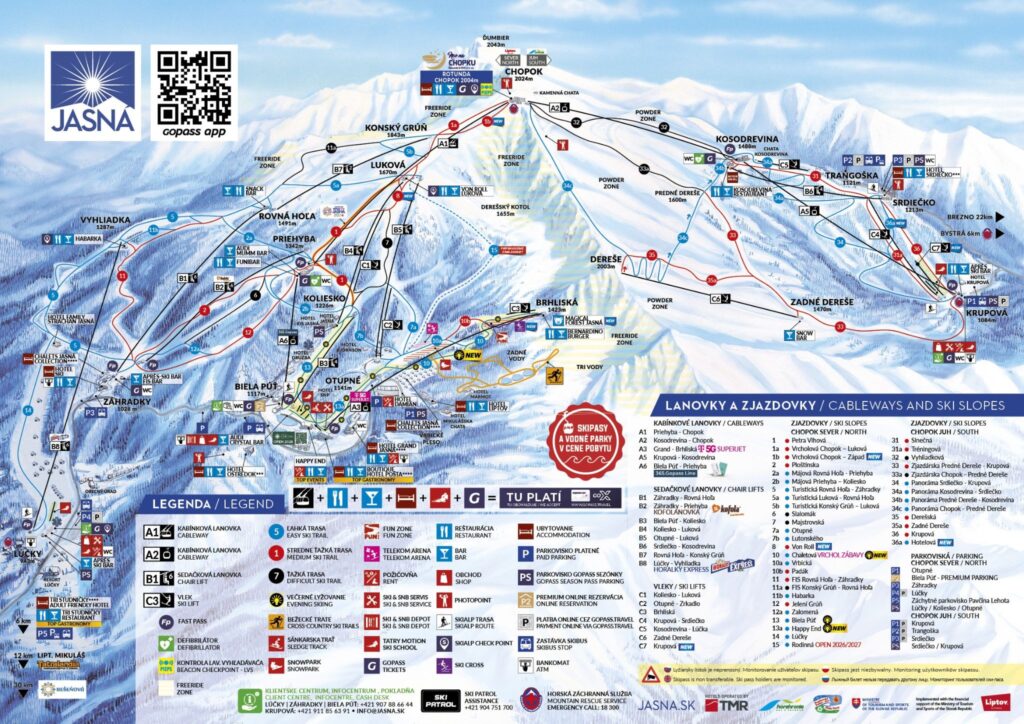
A specific example: In Jasná in the Low Tatras – the largest resort in Slovakia – the wide blue slopes like Biela Púť or Lúčky are among the best beginner trails. They are clear, gentle, and offer plenty of space so you don’t have to worry about other skiers. Conversely, it is best to avoid the southern side of Chopok during your first few days – the terrain there tends to be more challenging and windier.
Skiing methodology step by step
Now for the most important part – the actual skiing methodology. Learning has its own logic and a proven sequence of steps that works for both children and adults. If you follow it, you progress safely, and each new skill builds on the previous one. This is the core of the adult ski teaching methodology used by professional instructors.
1. Getting familiar with the gear and walking on skis
Before you even head down the slope, get used to your gear. Learn how to step into and out of the bindings, march on skis on a flat surface, practice turning around, and do a brief sidestep or herringbone climb up a gentle hill (“herringbone” meaning tips apart, tails together). It sounds basic, but this is where you get your first sense of being in control of your skis.
2. Baseline ski stance and balance
A stable stance is the foundation of everything. Flex your knees and ankles slightly so your shins press against the tongue of your ski boots, keep your center of gravity low and centered over the middle of the skis – do not lean too far forward or backward. Skiing comes from the legs, not the torso; make your movements with your legs and keep your upper body calm.
3. The snowplow – your first braking and speed control
The snowplow (or “pizza”) is the first way to slow down and stop, and all skiers start with it, both children and adults. Point the tips of your skis together and push the tails apart (forming an “A” shape), then gently press on the inside edges. The wider you push your tails and press on the edges, the more you will slow down or come to a stop. Be careful not to cross your tips. Try the snowplow on a flat surface first, then move to a completely gentle slope.
4. First turns and weight transfer
Once you manage braking, turning comes next. The basic principle is simple: put weight on your right foot – you go left; put weight on your left foot – you go right. From the snowplow position, transfer your weight to the outside ski in the direction you want to go, making slow, long turns across the entire width of the slope. Try your turns without poles first to fully master the weight transfer. Gradually, you will be able to shorten them and make them smoother.
5. Safe stopping and falling
Knowing how to stop at any moment is the bedrock of confidence on the slope – practice it by picking a spot ahead of time where you want to halt, and stop right there. And since falls are part of skiing, it pays to learn how to fall too: fall sideways toward the slope, keep your body relaxed, and do not put your hands underneath you. Feel free to try a few falls on soft snow on purpose – you will find out you don’t need to fear them.
Ski instructor or self-taught? Why a ski school is worth it
Theoretically, you can learn to ski on your own or with a friend who already skis. In practice, however, this is a much slower and riskier path. Without professional feedback, you can easily pick up bad habits that are hard to shake off later, and you will often spend way too much time fighting mistakes that a ski instructor could fix for you in a few minutes.
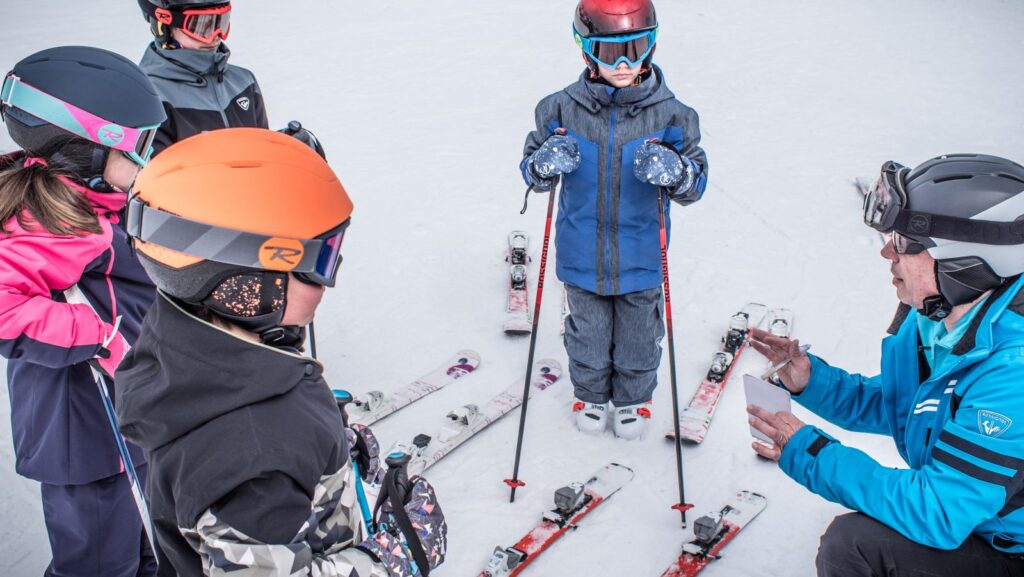
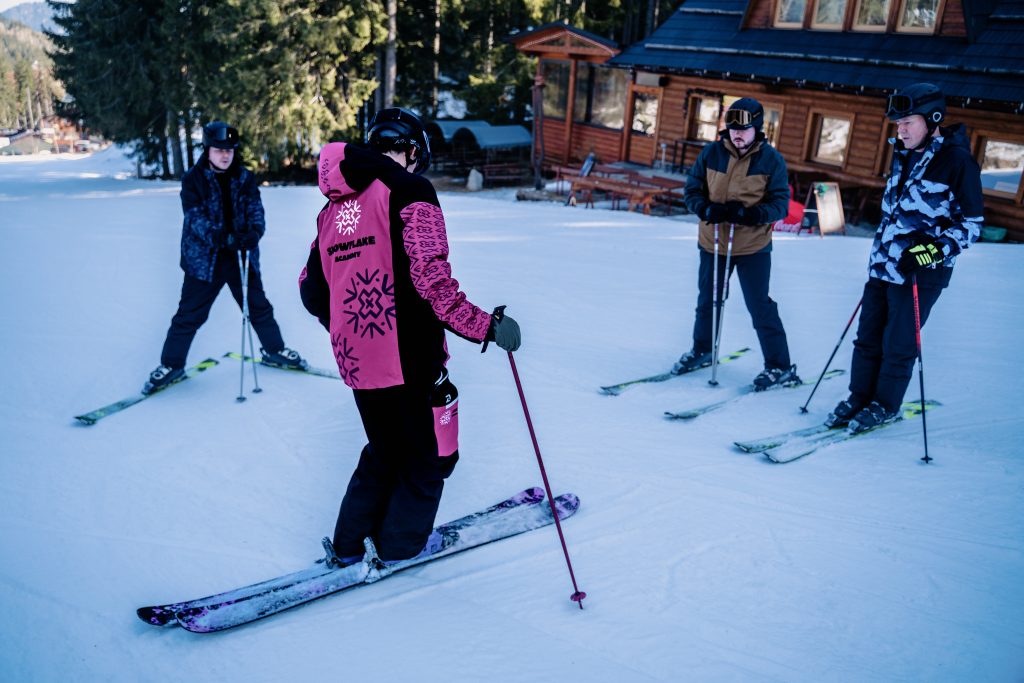
A professional instructor provides you with structure, proper technique right from the start, and above all, safety. For adults, an individual approach holds immense value – one instructor, one student, with the pace tailored exactly to you. This is precisely how private lessons work at the Snowflake Academy ski school in Jasná, where our instructors take pride in their patience and building the confidence of adult beginners.
A great combination is an instructor paired with high-quality instructional videos. Watching a good demonstration of technique before or after your lesson makes it easier to understand what the movement should look like – and the instructor can then fine-tune the details directly on the slope and correct what you can’t see yourself from a video clip. However, a video alone cannot replace an expert’s eye; this combination works best.
Before hitting the slopes for the first time, familiarize yourself with the basic rules of conduct on the slopes (the FIS rules) -they apply equally to beginners and experts and make the slopes safer for everyone.

How to progress faster in skiing: Consistency and rest
The pace at which you improve isn’t just determined by talent. How you structure your learning plays a massive role.
Consistency at the beginning works miracles
In the beginning, the rule of thumb is: the more often you are on skis, the faster you progress. Motor skills are best reinforced by repeating them shortly after one another – three consecutive days will push you significantly further than three separate weekends scattered across the entire winter. If you can, plan your first skiing experience for a few days in a row, rather than a single afternoon once a month.
Don’t underestimate rest between runs
Consistency, however, doesn’t mean grinding from morning till night. Tired legs lose their technique, and a fatigued mind stops processing instructions – which is exactly when unnecessary falls happen. Take breaks between runs, stay hydrated, keep your energy up, and don’t overdo the length of your skiing sessions during the first few days. A short, focused ski lesson with built-in rest will bring more results than an exhausting full day on the slopes. Additionally, quality sleep between ski days helps your body process and hardwire the new movements.
Common mistakes made by adult beginners
To wrap things up, here are a few mistakes worth avoiding right from the start:
- Striving for perfection on day one. Progress is gradual; do not rush it.
- Moving to harder slopes too quickly before you have confident braking and turns down in both directions.
- Using stiff or long advanced skis – they make learning harder and chip away at your confidence.
- Learning solely from a friend or videos without having your technique checked by a professional.
- Leaning too far forward or backward out of fear – your center of gravity belongs over the middle of the skis.
- Underestimating breaks and hydration, which leads to fatigue and falls.
Final advice
Learning to ski as an adult is not about age or talent – it is about the right approach, good guidance, and being patient with yourself. When you combine realistic expectations, the right gear, a gentle slope, and a step-by-step methodical approach, those first independent turns will come sooner than you think. And if you want to be absolutely sure you are building on the correct foundations from day one, start with a private lesson at a ski school – the snow, fresh air, and the joy of the ride will take care of the rest.